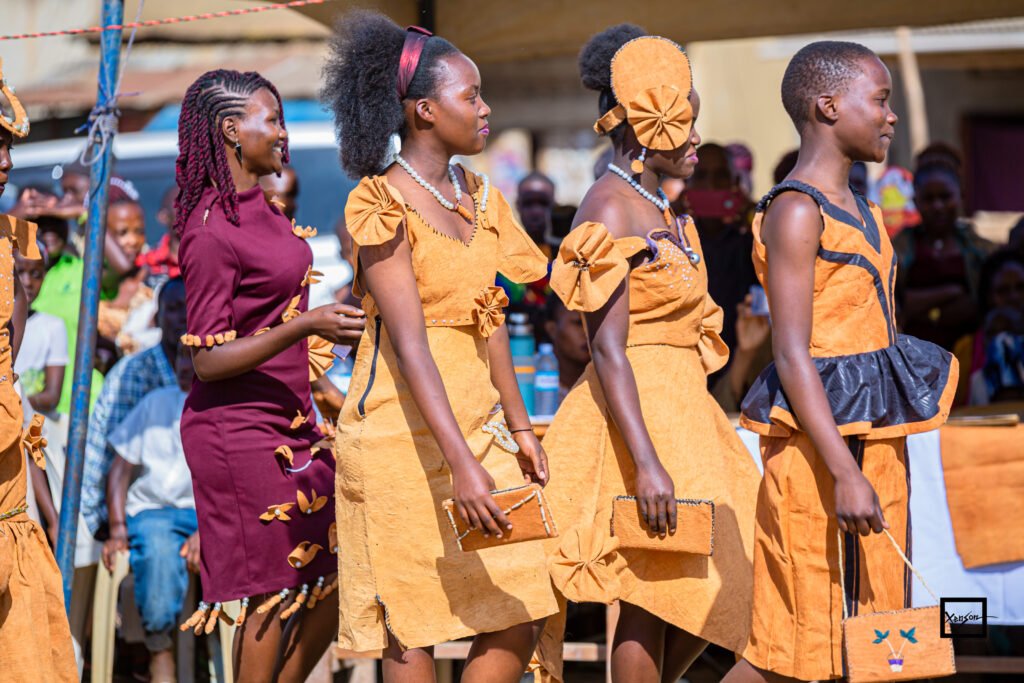
Why Barkcloth Is One of Africa’s Most Sustainable Heritage Materials
Olubugo, Barkcloth made from the Mutuba tree (Ficus Natalensis) has been produced in Buganda for so many years. It requires no factory, no synthetic input, and no industrial supply chain. On every serious sustainability metric, it holds up. The question is not whether it qualifies. The question is why it has taken this long for the wider world to pay attention.
The production system is the argument
Bark is harvested from the Mutuba tree by stripping a vertical section, then wrapping the exposed trunk with banana leaves to protect it during regeneration. Within a year, the tree produces a new harvestable layer. A single tree sustains this cycle for up to 20 years. Nothing is felled, nothing is replanted. The tree is a renewable resource in the most literal sense.
Once harvested, the bark is soaked in water and beaten with ribbed wooden mallets until it softens and expands into cloth. The process uses water and labor. It produces no chemical effluent, no microplastic byproduct, no carbon-intensive output. When the finished cloth reaches the end of its life, it returns to soil. There is no disposal problem because there is no synthetic component to dispose of.
Compare that to organic cotton, which consumes between 7,000 and 9,000 liters of water per kilogram of fiber. Or bamboo fabric, which is typically processed using sodium hydroxide and carbon disulfide chemicals that compromise the environmental case for the raw material entirely. Olubugo has no equivalent trade-off built into its production.
The knowledge system behind it
The Ngonge clan has held custodianship of barkcloth production within Buganda across pre-colonial, colonial, and post-colonial periods. That continuity is not incidental it is the mechanism by which the craft survived. Knowledge of which trees to harvest, at what stage, and how to read the bark’s readiness was transmitted within a structured social institution, not left to individual memory.
Masaka remains the center of production today. The artisans working there are not preserving a relic. They are operating a functional material economy that has outlasted every political disruption of the past century.
In 2008, UNESCO inscribed the practice on its representative list of the Intangible cultural Heritage of Humanity. What that inscription actually documents is a production system with intact knowledge transmission, active practitioners, and living institutional structure conditions that most heritage crafts have already lost by the time they receive similar recognition.
What the sustainability case actually requires
Olubugo performs well against any credible sustainability framework: the raw material is a native species managed without chemical inputs; the production chain is local and community-based; the manufacturing process is zero-waste; the finished product is fully biodegradable. No stage of production creates a problem that requires solving downstream.
What it currently lacks are not sustainability credentials. It lacks the investment infrastructure research documentation, supply chain development, material testing at scale that would allow it to compete in markets where those credentials are formally required. The Barkcloth Center is building that infrastructure. The material itself has never needed improving.
The global textile industry is responsible for roughly 10% of annual carbon emissions and is the second largest consumer of the world’s water supply. The search for alternatives is serious and ongoing. Olubugo is not a promising candidate. It is a proven one.